Activation: the first step toward better Retention
Products that don't focus on activating their users don't retain them. A concrete framework to improve activation, based on Amplitude's 2025 Benchmark Report.
I was going through Amplitude's 2025 Benchmark Report and ran into a chart that caught my eye. I obviously suspected this correlation existed — but not that it was this strong.
It shows the relationship between 7-day activation rate and 3-month retention.
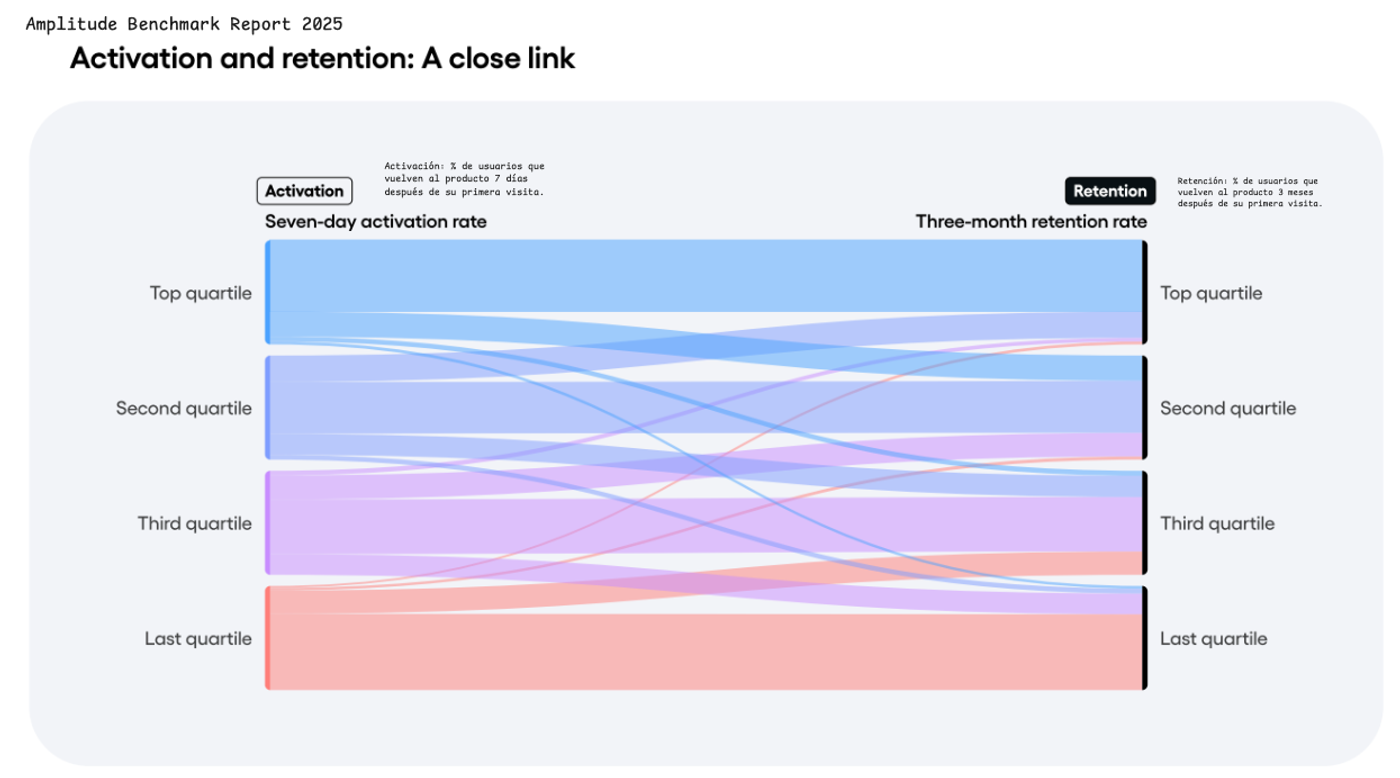
Takeaway: there's a high correlation between activation rate and month-3 retention.
👉 Products with a high activation rate retain way better at 3 months. 👉 Products with low activation retain poorly.
In other words: if your users don't experience real value early, they're very unlikely to stick around.
How to read the chart
On the left side is activation (% of users who come back to the product within 7 days of their first visit). On the right is 3-month retention (% who keep coming back after 90 days).
The bands show how products are distributed:
- Those starting in the top quartile of activation mostly end up in the top quartile of retention too.
- Those starting at the bottom almost always end up in the bottom quartile of retention.
The conclusion is simple: activating your users well in the first week is the key to long-term retention.
The goal
My takeaway after seeing this was concrete, and it should be every product / growth team's takeaway:
🎯 Goal: improve the activation rate by X% over the next month.
Ok, we get that activation matters… now the question is: how do we improve it?
A simple action plan
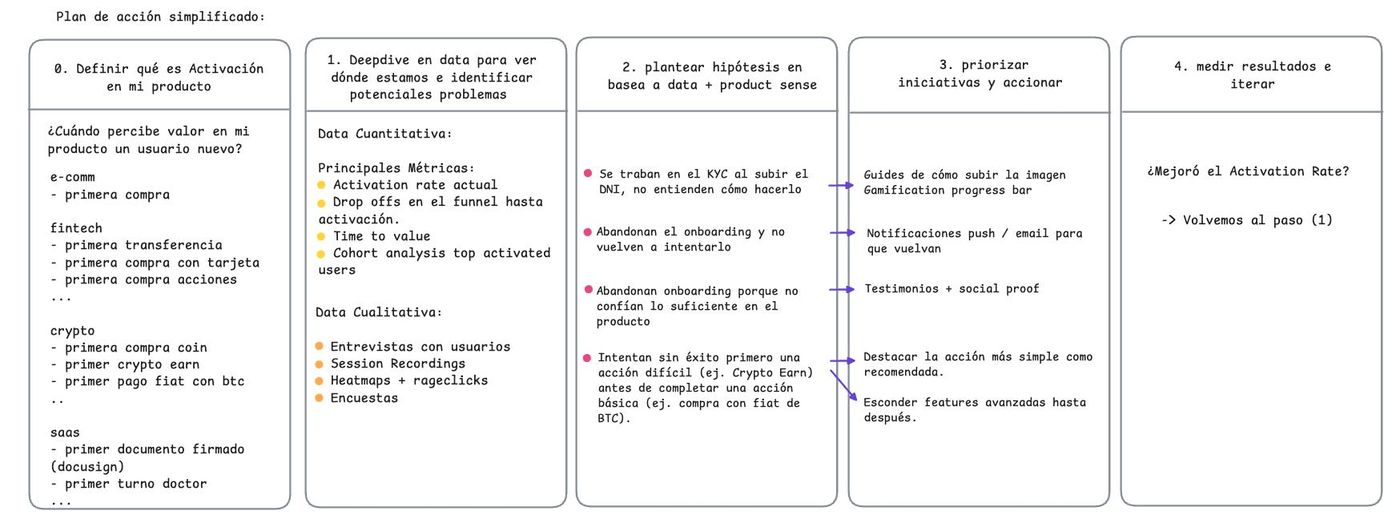
0. Define what activation means in your product
Activation is the first value action a new user takes. It can be a single one or several — it depends on the business.
The best people to define it are the product or growth owners. You can also look at it with data — for example, watching users who try different features and seeing how their retention varies.
Some concrete examples:
- E-commerce → first purchase.
- Fintech → first transfer, first card purchase, first stock purchase.
- Crypto → first coin purchase, first transfer, first fiat-to-BTC purchase.
- SaaS → first document signed (e.g. DocuSign), first doctor's appointment booked.
1. Deep dive into data
You need to understand where you are and why users aren't getting activated. This is done with two kinds of data:
Quantitative data — some key metrics:
- Current activation rate: % of users who use the key feature within the first 7 days post sign-up / app install.
- Drop-offs in the funnel up to activation.
- Time to value.
- Cohort analysis of activated vs. non-activated users: top features and paths used by those who do activate vs. those who don't.
Qualitative data:
- User interviews to understand frustrations.
- Session recordings to see where they get stuck.
- Heatmaps + rage clicks.
- Surveys to validate perceptions.
Combining both approaches is what gives you a real picture of what's working and what isn't on the path to that first value action.
2. Form hypotheses
With that data in hand, the next step is to try to decode it and form hypotheses about what may be going on. For example:
- They get stuck on KYC when uploading their ID and don't understand how to do it.
- They drop off after the first failed onboarding attempt.
- They don't trust the product enough and don't perceive initial value.
- They try a hard action first (e.g. Crypto Earn) before a basic one (e.g. fiat-to-BTC purchase).
3. Prioritize initiatives and execute
Here you should have a backlog of initiatives that address each hypothesis, prioritized by potential impact. For example:
- KYC: clear in-app guides, visual examples, progress bar.
- Drop-off after failure: push/email to bring them back.
- Trust: testimonials, social proof, security badges.
- Hard action first: highlight the simplest action, hide advanced features until later.
4. Measure results and iterate
Did the activation rate improve? Look at how each initiative impacted its specific metric (e.g. if it was focused on a particular funnel step) and the overall activation rate. Then iterate the whole process from step (1) again.
Conclusion
The conclusion is fairly simple: improving activation is the most direct path to improving retention.
You can spend on acquisition, but if the user doesn't go through that first value action, they're going to leave.
Activation is the hinge that decides whether your product is really going to grow — or stay a leaky bucket.
If you want to dig into this more, DM us.