How to build your Metric Tree step by step
Learn how to build your Metric Tree to identify which variables drive deviations — and fix them as fast as possible.
Learn how to build your Metric Tree to identify which variables drive deviations — and fix them as fast as possible
→ If you need help building your Metric Tree, write to me at guido@bildungdata.com
Don't do Growth without first building your Metric Tree.
What is a Metric Tree?
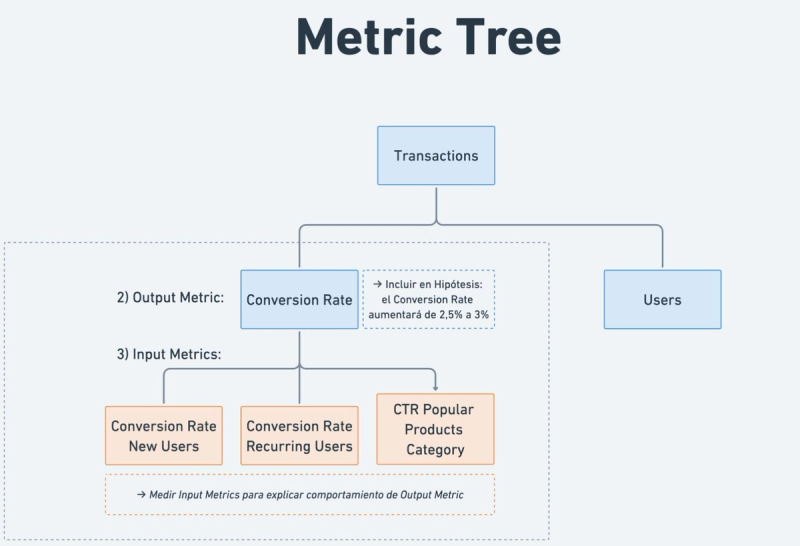
It's a logical representation of your business, identifying your target metric and the sub-variables that compose it.
To build the Metric Tree for your business / area, follow these steps:
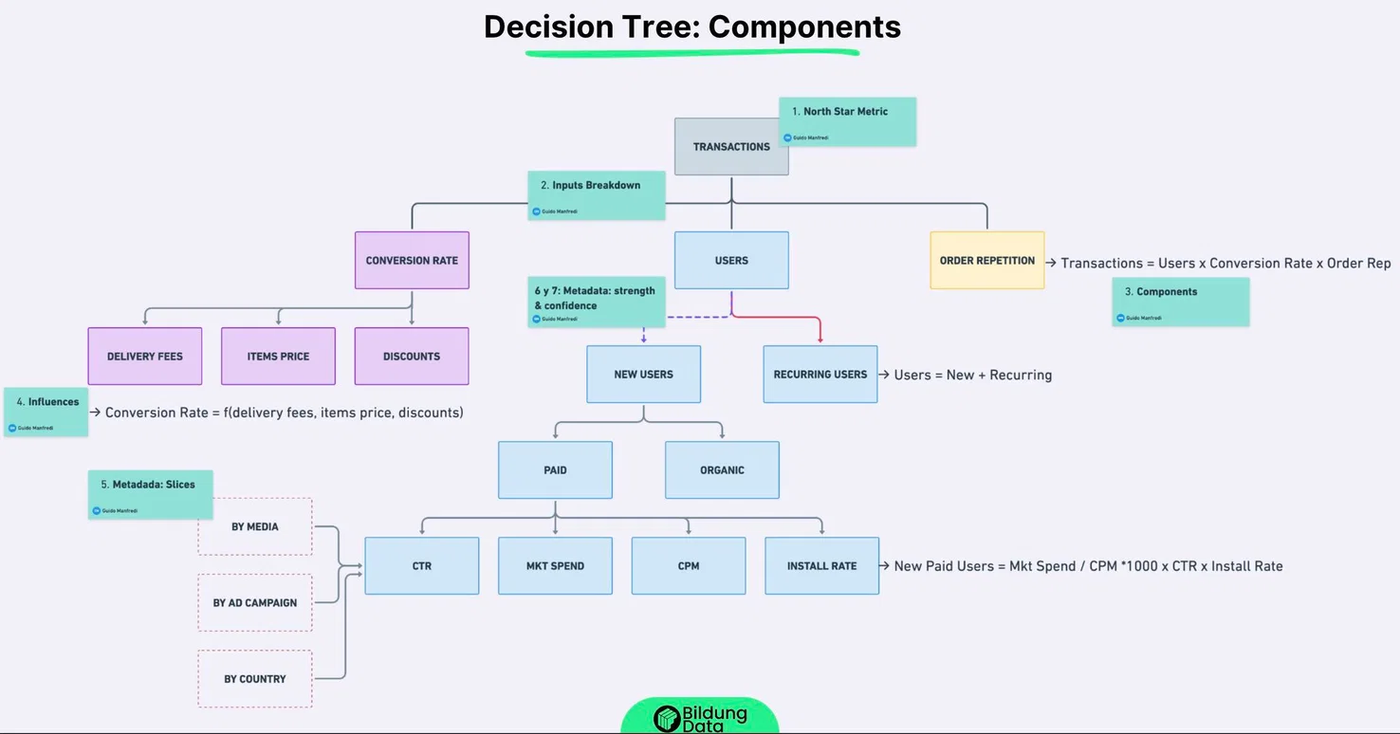
1️⃣ Define your north star metric
- Every other metric will be derived directly or indirectly from this one.
- It's usually revenue, profit, transactions…
2️⃣ Break down sub-metrics
- Start decomposing your north star into its inputs.
- Continue until you can't go any further.
→ In this step you'll use what we call "Components". They're mathematical, true-by-definition relations. For example:
→ Transactions = users x conversion rate x order repetition
→ Users = new users + recurring users
3️⃣ Add extra inputs: "Influences"
- These are sub-metrics that we know impact a given metric but can't express through a mathematical formula. For example:
→ we know Conversion Rate depends on shipping cost, pricing, offer, purchase funnel, but we don't express it as a formula.
4️⃣ Add metadata
- Two types of metadata to enrich the tree:
i) Relationships between metrics: identify how strong the relationship is (with color), and the confidence of that relationship (dashed / solid line).
ii) Slices: dimensions to break our metrics down by to analyze their behavior. For example:
→ marketing ad CTR we'll break down by Media, Campaign, Country, etc.
👉 If you haven't built your Metric Tree yet, you're spending effort on initiatives that probably aren't moving the metrics that actually matter.
👉 Once it's built, the next step is to build the dashboards that come out of it with a tool like Mixpanel.