The 6 Product Analytics Maturity Levels
The most basic teams have data but don't know what to do with it. The most advanced ones have Agents making decisions for them. In between, there are many possible levels of maturity — let's walk through them.
Most startups don't make it past level 3 (and that's why they don't grow)
There's a pattern I see all the time.
A startup installs Pendo, Mixpanel or Amplitude → builds some dashboards → someone looks at the numbers → everyone feels "we're already working with data".
But no.
That's not doing Product Analytics.
That's the starting point.
After working with dozens of teams across LATAM, we started seeing that everyone goes through the same levels. Some stay there. Others actually use data to grow.
To show the maturity levels we identified, we put together a matrix that lets any team understand where they stand and what they need to keep growing on this path.
The 6 levels of Product Analytics
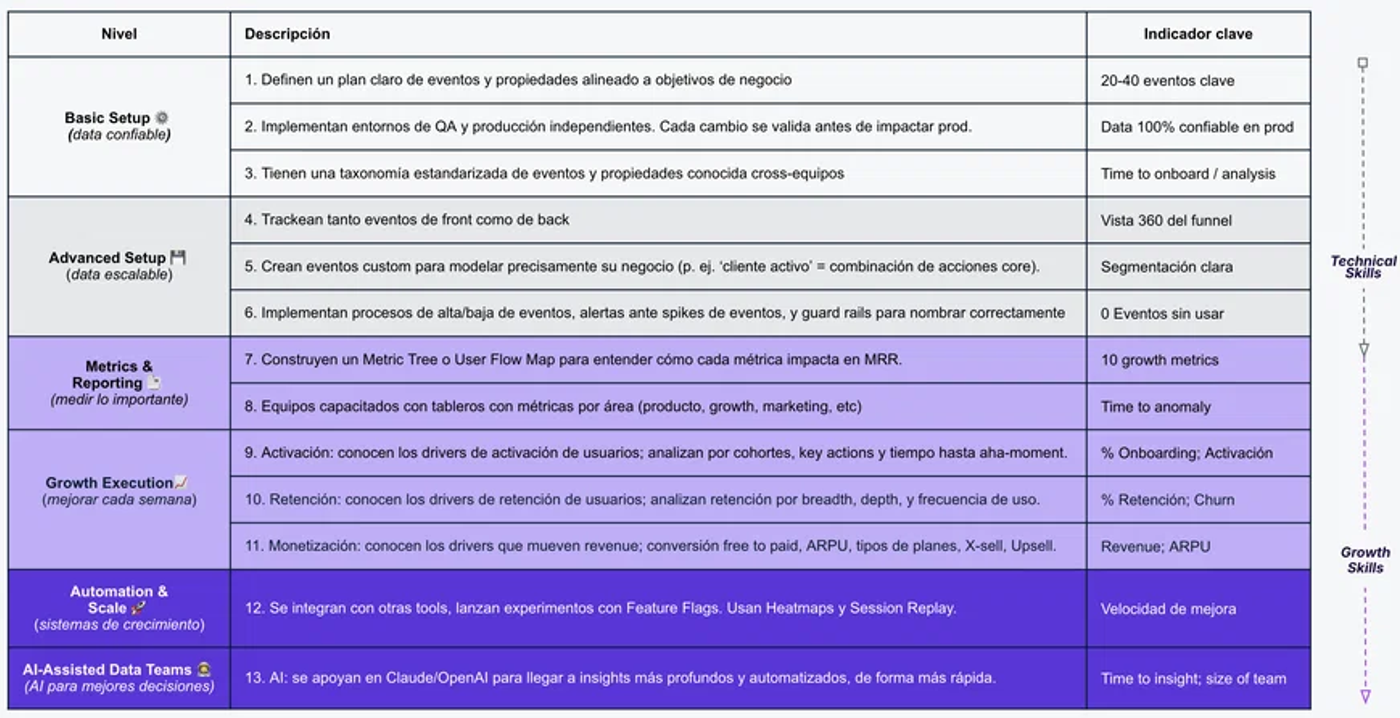
Level 1 — Basic Setup
The goal is a single one: reliable data.
- Clear tracking plan (20–40 events that matter, not 200 random ones).
- Separate environments (test vs prod).
- Consistent taxonomy (everyone speaks the same language).
If your data isn't reliable, everything else is noise.
Level 2 — Advanced Setup
Here is where you start doing things seriously.
- Frontend + backend events (full 360 funnel view).
- Custom events (model your business, not just track clicks).
- Data governance (manage data growth and avoid overpaying).
You're not growing with data yet.
But you're building the right foundation.
Level 3 — Metrics & Reporting
This is where most teams stay.
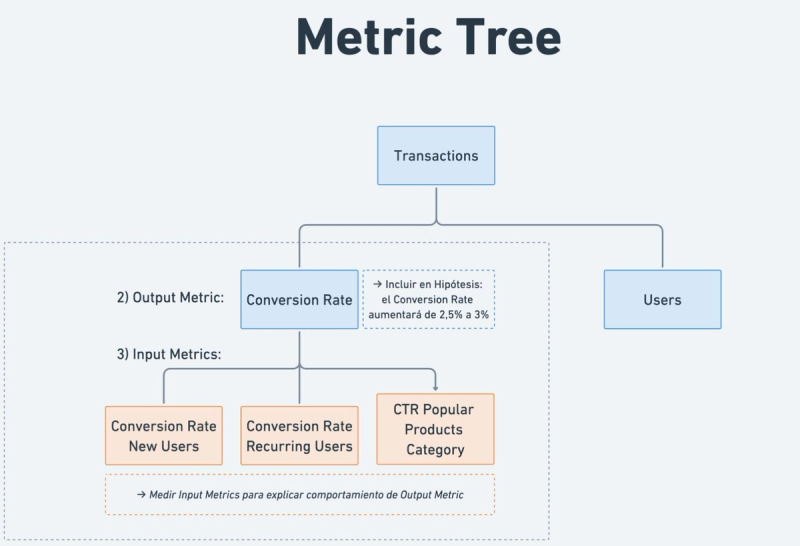
- You define metrics (ideally with a metric tree).
- You build dashboards.
- You monitor what's happening.
It's useful to detect problems.
Not necessarily to solve them.
Level 4 — Growth Execution
This is where everything changes.
You don't look at data anymore. You operate with data.
You go from data to action.
- Activation: you understand the "aha moment" and optimize the time to reach it.
- Retention: you analyze who comes back, how, and why.
- Monetization: you understand what moves revenue (conversion, ARPU, upsell).
The key difference: you make decisions every week based on real analysis.
Level 5 — Automation
You start scaling.
- You integrate analytics with action tools (e.g. OneSignal).
- Segments → automated campaigns.
- Experimentation (feature flags, A/B tests).
- Session replay, heatmaps, etc.
This is where you close the loop:
data → insight → action → impact.
Level 6 — AI
Few teams are here yet.
- You use AI to find insights faster.
- You automate analyses.
- You operate with smaller but much more efficient teams.
The game isn't just decision quality anymore.
It's speed.
The important question
What level is your team at today?
If you're at level 3 (or below), the next step isn't more dashboards.
It's this:
- Pick one metric (e.g. activation).
- Do serious exploratory analysis.
- Identify drivers.
- Generate hypotheses.
- Execute.
Repeat every week.
That's where real growth begins.
If you need help with this, write to me at guido@bildungdata.com