How to choose your Tech Stack based on your business stage
We walk through the key questions that come up at each business stage and the optimal MarTech stack you should consider — from Early Stage to Enterprise.
Let’s start with the basics: what is MarTech?
By definition, it refers to technology applied to marketing — the set of tools and technologies we can use across our digital products to grow and optimize both the product and the business.
And even though the name says "marketing," the scope reaches well beyond it: retention, growth, product, data, engineering, and customer support teams all rely on MarTech.
What are the common mistakes when choosing MarTech?
There are many, many different types of tools — Product Analytics, CEPs, MMPs, CDPs, Experimentation & Personalization, and more. Even the names sound like encrypted hieroglyphs.
A very common mistake is not knowing what kinds of tools exist or which ones are worth implementing as your product grows and matures.
Many of these tools can cost thousands of dollars per year — and if you buy them at the wrong time, they often end up collecting dust. Done at the right moment, though, they can drive exponential growth.
The goal of this article is to walk through each category of tool, explain what it lets you do, when it makes sense to adopt it, and share a few tips on how to keep costs down.
Early Stage: how do you validate your product from day one?
Key tool: Product Analytics
The phrase is a cliché, but it’s very true: what gets measured gets managed.
From day one, it’s critical to understand how your users are interacting with your product, which features they’re using — and which they’re not — and where they’re getting stuck. That’s what lets you make better product or growth decisions and improve the experience.
The category of tool that gives you that visibility is Product Analytics. The market leaders are Mixpanel and Amplitude.
They let you track every key action each user takes, and once you’ve gathered that data you can build reports to see exactly how people are interacting with the product.
With data you can answer: Where are users getting stuck in the flow? Which features do they value, and which ones don’t they? Who has churned? Which acquisition source converts best? What’s day-1, week-1, month-1 retention? You can also set alerts when errors spike or conversion rates drop.
Now, when you’ve just launched and only have a handful of users, can you really draw meaningful conclusions to make the right decisions?
When you’re starting out you’ll have low user volume and limited data, so the use case for Product Analytics can look very different early on than later on as you grow.
Let me walk through an example that will make it clearer.
A friend of mine spent a few months working on a project where they launched an app that lets farm and ranch owners manage their operations.
Since he’s passionate about data, the first thing he did was implement Mixpanel to measure the activity of every user they brought in. The nice thing about these tools is that you can look at aggregated data — if you have 100 users, what are most of them doing — but you can also drill all the way down to individual user level.
In the first month they maybe had only 10 users, so what he’d do was review each one’s activity, looking for insights into which features they were using — and which they weren’t. For example, he saw that the main use case was adding animals and logging when they got vaccinated for tracking purposes. Meanwhile, another module they’d spent many engineering hours on — designed to log sales of crops and livestock — hadn’t been touched.
With that early data they could already understand which features were most valuable to their users. Combining it with qualitative input — interviews, for instance — they could keep building new features to expand the product in those directions.
That’s the product angle. On the acquisition / marketing side, they could use those insights to focus their ads on the messages that were resonating most. And from support, they could personally call users who installed the app but never used it, or who got stuck at a particular point.
Two big takeaways here:
1) The importance of having data the moment you launch, so you can make better decisions.
2) That at launch, it’s perfectly fine to do things that don’t scale.
Clearly, once you have hundreds or thousands of users, you’re no longer reviewing activity user by user, nor calling each one personally. On the data side, you’ll group users into segments — known as cohorts — and draw conclusions at the group level. And on the communication side, you’ll look for tools that let you send messages and personalize experiences at scale.
Scale Up: how do you scale communication with your users without losing personalization?
Key tool: Customer Engagement Platforms (CEPs)
When your user base grows, you need tools that let you manage and personalize communication at scale. Platforms like OneSignal, Braze, or Clevertap automate the delivery of personalized messages across channels like email, push notifications, and SMS.
You can also integrate your Product Analytics tool with your Customer Engagement platform.
In Mixpanel you can build a funnel of users who completed Sign Up but haven’t yet tried a key feature (for example, making their first deposit in a Fintech app, or their first purchase in a Marketplace). You can save those users as a segment (a cohort) and sync it to OneSignal. From there you can send them push notifications, emails, in-app messages, or SMS to nudge them toward that high-value action.
Scale Up: how do you measure the impact of your campaigns?
Key tool: Mobile Measurement Partners (MMPs)
If your product is mobile-first, attribution tools like Appsflyer, Adjust, or Singular are essential. These platforms help you identify where your users are coming from (Meta, Google, TikTok, etc.), measure downstream conversions, and decide where to allocate your budget more intelligently.
Here’s a concrete example: before installing an app, I clicked on an Instagram ad, three days later one on YouTube, and finally installed after clicking a TikTok ad. If you look at each platform individually, every pixel may claim the install — each one saying I installed after their ad.
What an MMP does is act as a centralized source of truth that can see the full journey. With different attribution models, you can assign weights to each of those touchpoints so attribution is fairer — and from there make smarter decisions about which campaigns deserve more budget.
This applies to paid media, but also to any links you might use in referral campaigns, emails, and more.
Now, if you don’t have an app and your product is 100% web, the good news is you don’t need an MMP — your Product Analytics platform can handle this kind of analysis with UTM tags. In Mixpanel you can see how each media source is performing, based on the users who landed on your site from each one and whether they converted or not.
Enterprise: how do you centralize and scale your data?
Key tool: Customer Data Platforms (CDPs)
When I was CPO at Wabi, one big pain we had was that we were integrated via SDK and tracking events across multiple platforms: Mixpanel, OneSignal, Meta Ads, Google Ads, Appsflyer...
This led to two major problems:
1) Every time we wanted to track a new event, the engineering team had to implement it for each SDK individually.
2) Values for the same event often differed across platforms.
A CDP like Segment or Rudderstack solves this: it ingests all your events into a single source, and from there you set up destinations and decide which events to forward to each — your Product Analytics platform, CEP, MMP, Meta Ads, Google Ads, etc.
Enterprise: what are the benefits of owning your own data?
Today, the most advanced stacks are even moving past CDPs, opting instead to track events and store them directly in their own Data Warehouses (BigQuery, Snowflake) or Data Lakes.
These give you full control over your data. You can combine multiple sources, transform them however you like, and store them in different formats.
For example, you can store user event data alongside paid media ad spend, revenue (the classic case where transactions need exchange-rate updates), CRMs, surveys, or other sources to enrich it.
On top of that, the more advanced MarTech tools today integrate directly with these warehouses. Mixpanel, for instance, lets you ingest data straight from any Data Warehouse and stay in sync. So if a historical value changes (say, the GMV of a transaction that was refunded), that value gets updated in Mixpanel too.
Another advantage is that it prepares you for the AI era: owning your data is essential to feed your own models, and the future will likely surface many more benefits we can’t fully predict yet. What’s certain is that any of them will require independent control over your data.
On the downside, you need a specialized data team that can build and maintain these foundations. With a more packaged solution like a CDP, you give up flexibility — but you also lower setup and maintenance costs.
Enterprise: how do you optimize experimentation at scale?
Key tool: Experimentation Platforms
At large volumes, even a small percentage improvement in conversion rate can translate into significant revenue. That’s why, at this stage, experimentation becomes critical.
Tools like VWO, Kameleoon, or AB Tasty let you run A/B tests and personalize experiences at scale to maximize results.
The truth is, we see few companies in LatAm treating experimentation as a core part of their strategy. To make it work, you need a dedicated team with a prioritized backlog of experiments running every sprint.
Conclusion
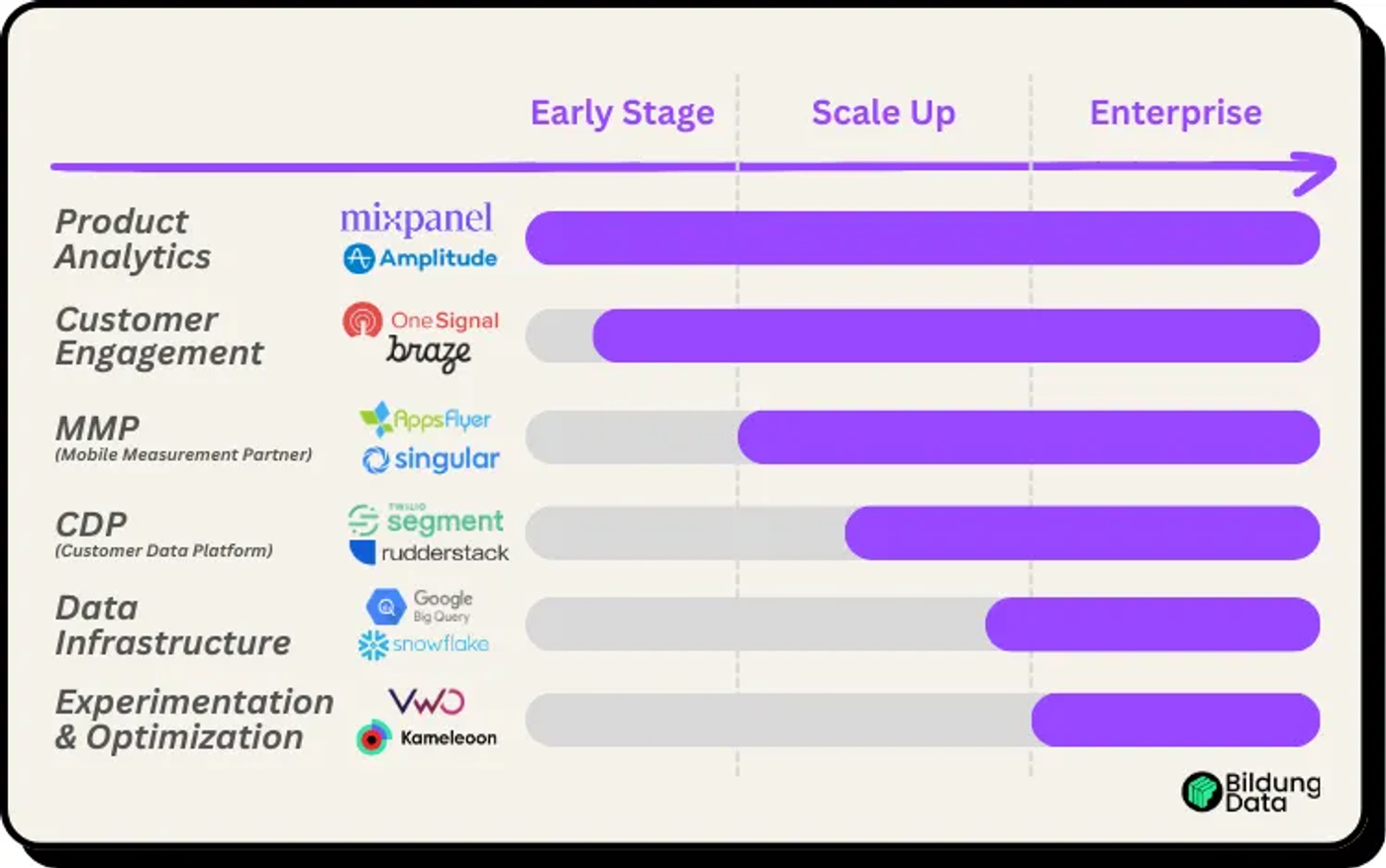
The ideal MarTech stack depends on your stage of growth.
In Early Stage, start with Product Analytics to understand your users.
In Scale Up, add CEPs and MMPs to manage communication and measure campaign impact.
In Enterprise, invest in CDPs, Data Warehouses, and experimentation tools to operate at scale and continuously optimize.
Choosing the right tools at the right time can transform your business and prepare it for what’s next.
Reach out if you need help defining your MarTech stack.